
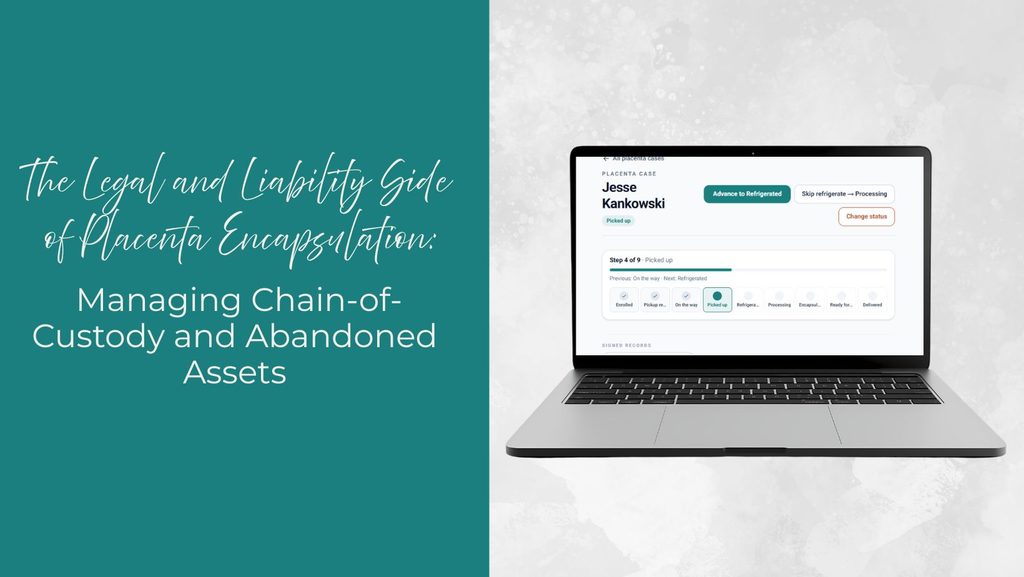
When you handle biological materials like placentas, you aren’t just providing a wellness service—you are managing a high-liability biological asset. Between strict health department regulations, medical disclosures, and the unpredictable nature of the postpartum period, legal protection must be built into every step of your workflow.
Many new encapsulators rely on manual paperwork, signed PDFs, and casual text messages to track assets. However, as your practice grows, this informal approach creates massive liability gaps. Here is how professional specialists manage chain-of-custody documentation, payment gates, and abandoned asset policies.
1. Why a Bulletproof Chain of Custody Is Legally Mandatory
The moment a placenta is delivered in a hospital room or home birth setting, its custody shifts. If a dispute ever arises regarding contamination, mishandling, or asset mix-ups, your agency must be able to prove every single physical transfer.
A complete digital chain of custody should capture:
- The Initial Request: Timestamped confirmation of when the pickup was triggered by the client.
- The Transfer of Custody Form: A signed digital agreement confirming who took possession of the asset, the exact time, and the condition of the transport container.
- Processing Milestones: Clear logs of when the asset was refrigerated, defrosted, and when the 72-hour safety clock began for steaming or dehydration.
- Proof of Delivery: A final digital signature upon capsule drop-off confirming receipt.
2. Eliminating Financial Risk with Automated Payment Gates
One of the most common administrative traps in placenta encapsulation is finishing the processing work, delivering the capsules, and then chasing down final payment via Venmo or checks.
To protect your business from unpaid invoices and awkward drop-off confrontations, implement a System Financial Gate:
- Card on File Requirement: Secure a valid credit card during the initial contract signing before any physical services begin.
- The Delivery Lock: Configure your software or workflow so that the final “Ready for Delivery” milestone remains strictly locked if the final balance is unpaid.
- Flexible Resolution: If an automated card charge fails, the system should instantly prompt the client to update their payment method in their portal, or allow you to toggle a manual cash/check override only when offline payment is confirmed.
3. Handling Abandoned Assets and Storage Thresholds
What happens when capsules are fully processed, but weeks go by and the client stops responding to messages? Leaving completed biological products in your storage indefinitely creates severe legal and operational liabilities.
To solve this, professional agencies enforce clear contract terms and automated safeguards:
- Storage Clauses: Ensure your initial client contract clearly outlines your agency’s holding period (e.g., storing capsules for up to 30 days post-completion) and the protocol for uncollected goods.
- Automated Client Nudges: Set up automated reminders that fire daily after a tenant-defined threshold is met, prompting the client to schedule their drop-off.
- The Final Disposal Gate: If a client fails to respond past your hard cutoff date, require a mandatory digital sign-off and disposal log. Your software should prompt you to record the final disposition (Archived/Destroyed per Agreement), securing a digital audit trail that protects your agency and clears the file from your active client list.
Conclusion
Placenta encapsulation is deeply rewarding work, but it requires rigorous operational discipline. By digitizing your chain of custody, enforcing automated financial gates, and establishing clear protocols for abandoned assets, you safeguard your health, your clients’ safety, and your agency’s legal standing.
Ready to stop wrestling with administrative tasks and give your practice the professional infrastructure it deserves? Visit www.BirthFlowApp.com to start your 7-day free trial today and experience how effortless automated intake, digital chain-of-custody tracking, and built-in legal protection can be for your placenta encapsulation business.